






Tamás Csidei is an expert in sous vide and has been developing the technology for 15 years, and education. He is also an important contributor to our series, as his professional activity and his comprehensive knowledge of the subject can greatly help in the interpretation of suicide.
How long have you been involved in gastronomy?
For a long time, 40 years if you look at the origins. We really didn't like the school canteen food we paid for, most of the time we didn't even eat it, we just left it. Then, when we were ten or twelve, we decided to use the money our parents gave us for lunch to go shopping and cook something for ourselves at home. We started with ham and eggs, then we made up more and more complicated things on the way home. Sometimes we cooked at one's home, sometimes at the other's. And when it came to choosing a career, there was no doubt that I would be a chef.
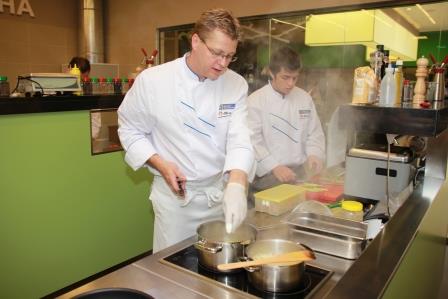
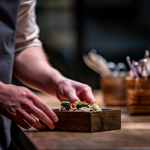
Tamás Csidei in the kitchen
Of course, this was not very much in line with what my parents had in mind, because they would have preferred to see me in a teaching or legal career, according to our tradition. But I persevered and became a chef out of defiance. Both my grandmothers were great housewives, a cliché, but it's true that I can still taste the old home cooking in my mouth. My grandfather was a lawyer and a winemaker, a love that is also in my genes, I wish I could spend more time in my 150 year old wine cellar and learn small but exclusively traditional winemaking.
How? Why did you get involved in sous vide technology?
Professor Kürti once said that we know more about the internal temperature of the planets than the temperature of a rice paddy. This ignorance and disinterest characterised Hungarian gastronomy at the time of the regime change. I first encountered the technology and some of its elements in Austria, but I didn't know what it was then. Everything was already there, meats, vegetables we vacuumed - partly for ageing and partly for conservation. And from France sous vide products were also in the freezer. Then later I read about sous vide again in the context of Madrid Fusion, then tried it, experienced it and got hooked. I like to specialise, to strive for perfection in a certain segment.
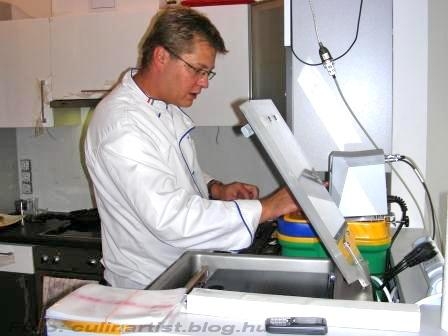
Tamás Csidei at work
What inspired you?
A sous-vide an old love! I've always been looking for a way to get better results from heat treating meat. I have researched, tried and perfected every technique. Eventually I became obsessed with hair-trigger temperatures. Then vacuum bagging came along, I read about it, tried it and fell in love. I was so excited to have found a possible key to perfect cooking that I had to share it with someone immediately. That's why I started working on it and publishing about it about 15 years ago.
Who or who inspired you to get involved?
My ignorance, my fears, my excitement for the new. I know very valuable people who are both human and professional role models. They are the successors of a world where there are hardly any professionals left, and good professionals are hard to find. These people are my role models, who are not just chefs for a living, but chefs with a passion for their craft. Yet it is never the people I recognise and admire that inspire me most, but the new opportunities.
There are many different ways to describe sous vide. I mean cooking under vacuum, but it's much more varied.
The key difference is the tools used, and consequently the hairpin temperatures below the protein denaturation point, a non-scientific process I call „bagging in a bag”. One thing to note about sous vide cooking is that a distinction is made between direct and indirect cooking. It is also important to check everything from the conditions under which the animals are kept, through feeding, to the age at slaughter, and from the time after slaughter, through transport at a safe temperature, to professional preparation. For products that are not used immediately, to cooling in the shortest possible time - which involves precise control of core temperatures - and then to precise compliance with storage temperatures.

Can a single degree temperature rise in the cold store halve the shelf life of the product?
A good example to illustrate safety is the case of the perfect egg: you can make a safe egg in 45 minutes in 64.5 degrees Celsius water, but the proteins are denatured, so you have done nothing technologically worthwhile, you have just treated the product for an unnecessarily long time. But if „we heat-treated it at a minimum of 57 degrees and for at least 75 minutes, we made it safe by pasteurizing it so that the proteins could not denature” (Schuman et al., 1997).
The technology requires a heat treatment equivalent to 90 0C for 2 minutes, following the 6 D principle, which results in a six order of magnitude reduction of C. botulinum spores.
So the point a in inverse proportionality to in pasteurisation the time interval of which depends on the fat, protein and starch content of the raw material, its freshness, its size and, of course, the temperature of the heat treatment medium and the core temperature of the product. Another very important factor when considering the heat treatment time of products is the determination of the weight, since from these data it is possible to draw clear conclusions about the degree of leaching between the technological steps and from the data obtained here it is possible to calculate and record the exact percentage of heat treatment and baking loss.
What is the difference between cook-chill and sous vide?
Very simply, we are talking about two completely different things, like apples and pears. Of course, they can and should be crossed. Cook&Chill is part of HACCP, whereby food prepared using conventional technology is chilled in a blast chiller and stored refrigerated until regeneration before consumption. Sous-Vide Cook&Chill is the integration of Sous-Vide into the process of good manufacturing technology. If, for example, the Sous-Vide semi-finished product is frozen, we talk about Sous-Vide Cook&Freeze.
The aim is to cool hot food quickly to a safe temperature range, in such a way that the texture and nutritional value of the food remains unchanged and the finished or semi-finished product stays in the dangerous range of 10-50 degrees Celsius for as little time as possible. Spore or vegetative forms of some bacteria survive the cooking phase and pose a permanent hazard after cooking. To minimise this, food should be cooled to below 10ºC within 1.5 hours. Flash freezing is usually carried out with air at -18 ºC to -40 ºC circulating at 5 m/s around the food to be cooled, rarely using liquid nitrogen vapour or solid carbon dioxide.
What is used in restaurants is not completely sous vide?
It is difficult to maintain strict technological discipline in restaurants. First of all, all work processes must be precisely integrated in the HACCP system, which is the primary one, safety, hygiene, perfect quality, microbiological preservation. To protect the technology, I have developed a 10-step food safety system, to ensure that the more microbiologically contaminated domestic fresh raw materials can be safely heat treated and remain germ-free for a long time.
Is this actually chemistry?
Cooking at inappropriate temperatures can lead to the development of Clostridium botulinum bacteria, which can cause highly toxic botulism, food poisoning. Learning how to use heat and measuring equipment correctly is not an easy but essential task, which is why I teach it. You should measure the temperature of the centre of the food in the bag. The other main requirement is to immediately cool/ or freeze the food to 3 degrees Celsius and then store it chilled at the correct and constant temperature. In all cases, it must be understood as a technology that has been subjected to a serious control and in which food safety rules are observed to the utmost.
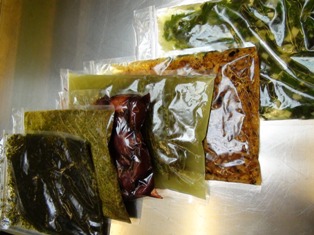
Raw materials, vacuum bags, slow cooking for a given time, regeneration, shocking... that's the general idea. In sous vide, it's when you freeze with nitrogen at the end, which is what chef Dr. János Kiss experimented with, how does that relate?
Chef János Kiss is a genius! He practically understood, applied and perfected a technology that most people today are unable to understand and comprehend properly. If frozen, liquid nitrogen is the quickest and best solution, but after proper pasteurisation it is not necessarily necessary to freeze, without it the shelf life can be very long.
Source: Airchef
Photo: Gastronauta Ltd.
Sous vide technology from space travel to Hungarian developers
„I first introduced sous vide to the Hungarian public in 2000”