






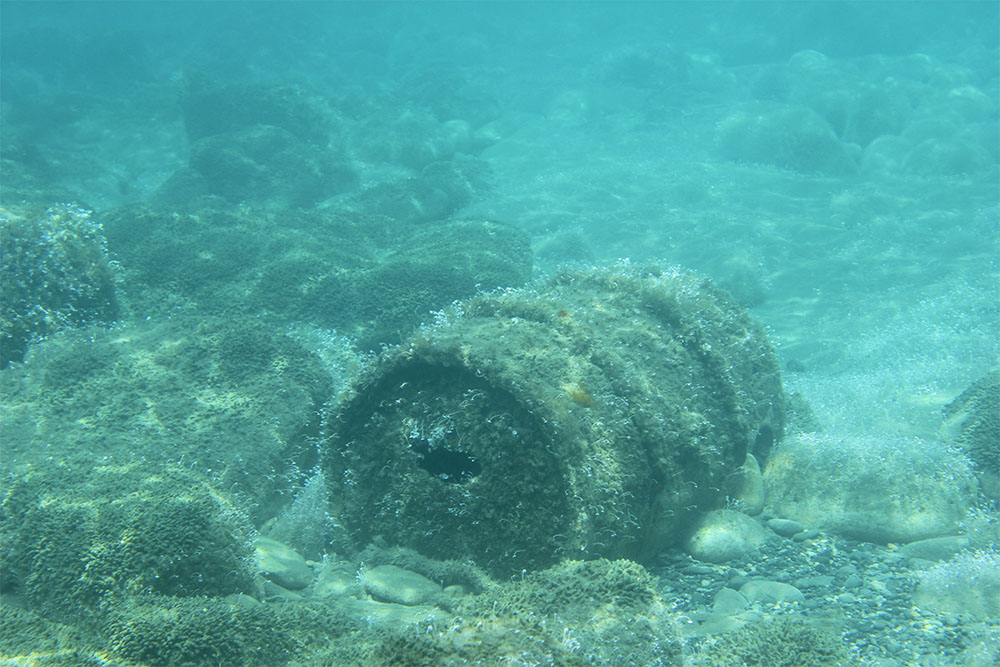
12 metres deep in the Atlantic Ocean, a dark figure appears in the salty, bluish-green haze. Something box-like, rectangular, resting on the seabed. Not a pirate's chest full of gold from Portugal's maritime past, but a different kind of treasure: the world's first ocean-aged vintage Port wine.
Just a few months ago, the Van Zellers & Co. dumped this series of 102 cylinders into the port of Sines, but it didn't take long for the sea life to catch up with him. The bottles are covered in seashells and white lace. Stars are stuck to the metal bars and fish swim between the necks of the bottles. As part of an expanding underwater winery set up by the Ecoalga - Adega Do Mar dive centre on the Alentejo coast, Van Zellers' port will be brought back to dry land on 16 November. It will then be sent to customers who have pre-ordered limited edition bottles.
Where did it start and where are we looking?
Although this is a new step for Portugal's famously strong wineries, the underwater ageing of drinks has been spreading rapidly for some time. Spain's Borja Saracho began studying the concept in 2008 and was granted permission to install two concrete and steel structures in the Bay of Plentzia, holding wines from 27 different Spanish producers. Thus, the Crusoe Treasure Winery was born. Underwater wine cellars have sprung up all over the Mediterranean and in places as far afield as South Africa, Australia and Brazil.
The logistics are not exactly straightforward: the special, leak-proof wax-sealed cylinders are sunk in crates or safes, usually between 10 and 20 metres deep, for periods of six months to three years. Some vintages are further matured in dry cellars before or after immersion.
So why is it good?
„As far as water is concerned, we actually find perfect ageing conditions, which means low light and stable temperatures,” explains Francisca Van Zellers, 15th generation keeper at Van Zellers & Co. „At a depth of 12 metres there is also an additional atmospheric pressure. This essentially speeds up the ageing of the wine.” It's not that they are ‘better’ or worse than their land-based counterparts,it's more a different process. A little open up more, become more expressive, which is a sensory difference, not necessarily a chemical one.
When the Argentinian winery Wapisa began experimenting with ocean ageing, owner Patricia Ortiz was surprised by the results: „Our wine, which spent eight months under the sea, had a more complex aroma and flavour, with a significantly fruitier than the versions aged in our cellar. It had a much longer finish and no signs of oxidation.” According to him, eight months of under the sea so, than six or seven years in a cellar.
The Hungarians have a hand in this too
This is echoed by Gergő Borbély, co-founder of ElixSea in the Basque Country, who says that ocean-aged wines „show increased aromatic intensity, lower tannin levels and a much riper body than their land-based counterparts.” This is not to say that mastering the process was easy. „Our first results were a bit disastrous,” he laughs. „Six bottles of wine, with a leaky seal, wet cork and a salty taste. But we were very enthusiastic and giving up was never an option.” Fortunately, in the second round, „our winemaker tasted the wine we'd brought up from the sea, looked at us in disbelief and asked, ‘How did you do that?’”
The only place where you won't find ocean-aged wine for the time being is in the US, where regulators are not looking favourably on the trend.In 2017, 2,000 bottles had to be confiscated and destroyed from Ocean Fathoms in California after authorities found that the owners had illegally dumped crates in the Santa Barbara harbour. Should we be worried about these underwater cellars harming marine ecosystems? On the contrary, Borbély says, if they are placed in regulated locations and well anchored, they can act as artificial coral reefs that enhance biodiversity. ElixSea's Costa Brava site alone provides about 400 times more space for „the smallest creatures to colonise and filter hundreds of litres of sea water a day, capturing carbon dioxide dissolved in the water.” The Crusoe Treasure employs a marine biologist who has counted around 100 species of plants and animals living on the winery.
According to Van Zellers, their ocean-ripened releases can make people aware of the importance of marine health. The shell-shaped bottles used for Vintage Porto 2020 Ocean Aged bottles are made from plastic waste collected from Portuguese beaches, with the proceeds going to support an educational programme at the Lisbon Aquarium. „The ocean has long been the lifeblood of Portugal - in fact, 97% of our territory is water - but we need to do more to protect it. When you open a bottle of this vintage port, literally clothed in marine life - as its bottle is covered in tiny shells - „you immediately start a conversation.”